


Backbone networks: The foundation of performance
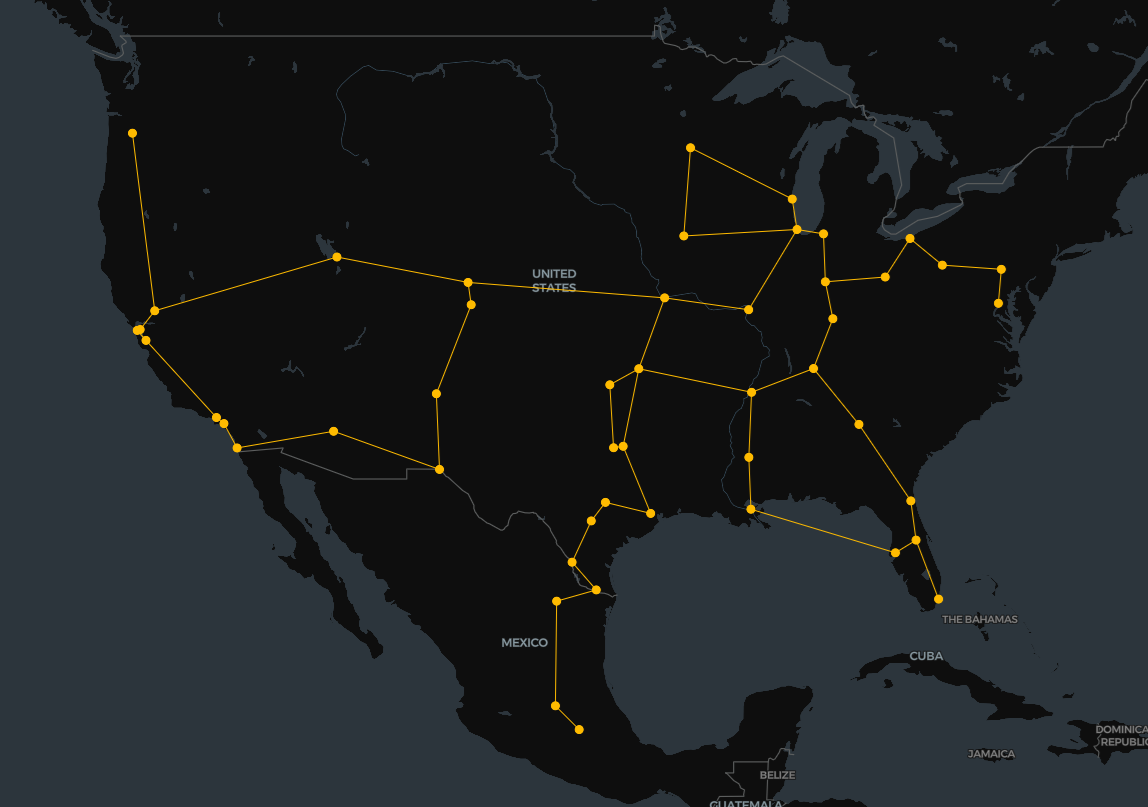
Global backbone networks form the critical foundation that supports cloud services, online applications and data-intensive AI processes. These networks interconnect large data centers and points-of-presence, enabling seamless access to compute and storage resources across regions.
But planning them is no small task. It requires dimensioning IP capacity between data centers, leveraging underlying optical infrastructure and ensuring resilience against failures. Traffic is growing 20–40% year-on-year, often unpredictably. New sites are being built at an accelerated pace. Plans must stretch across long time horizons. Poor planning risks service disruption, lost revenue and wasted capital.
The cost of getting it wrong
Provisioning too little capacity leads to congestion, downtime and churn. Provisioning too much wastes capital on underutilised fibre and IP links. The value of getting it “just right” is huge:
- Aligned investment with demand
- Stable performance under variable load
- Improved customer experience
- Strong ROI and scalable, right-sized capacity
Key issues with current backbone planning
1. Siloed Optical vs. IP Planning
- Separate teams handle optical transport and IP planning, leading to sub-optimal, uncoordinated decisions.
- Meanwhile, hardware convergence (e.g., coherent pluggables in routers) is blurring the line between layers.
2. Per-Link Traffic Estimation
- Forecasting growth on individual links is unreliable in fast-moving networks.
- A shift toward Networks-as-a-Service suggests bandwidth provisioning will align with compute and storage.
- It makes more sense to plan per-site ingress/egress capacity (at each data centre or POP) rather than per site-to-site link.
One Plan, One Backbone: Coordinated Optical + IP Planning
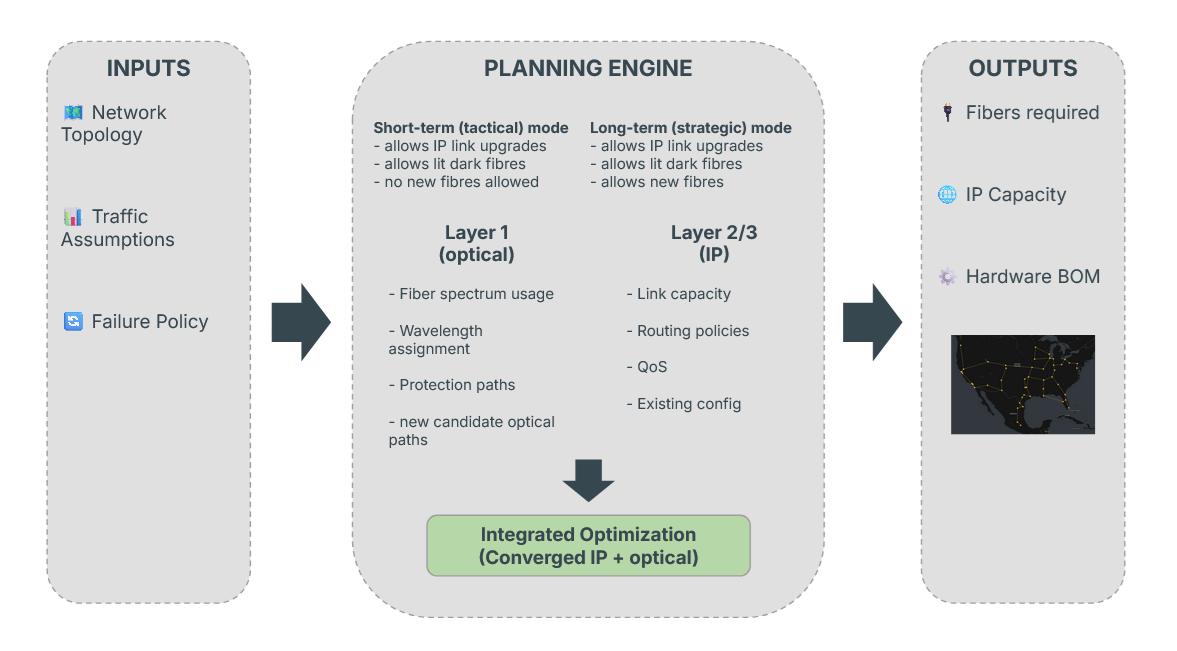
Planning optical (Layer 1) and IP (Layer 2/3) together means treating the network as an integrated system.
- Eliminate misalignment – Align IP and optical capacity to avoid stranded spectrum and underutilised links.
- Maximise efficiency – Prevent duplicate overbuild, reducing CAPEX (fewer transponders and ports) and OPEX (lower power and cooling).
- Leverage convergence – Exploit tighter integration as optical and IP hardware evolve together.
- Strengthen resilience – Apply failure protection consistently across layers without waste or gaps.
Rethinking traffic estimation: From Pipe to Hose
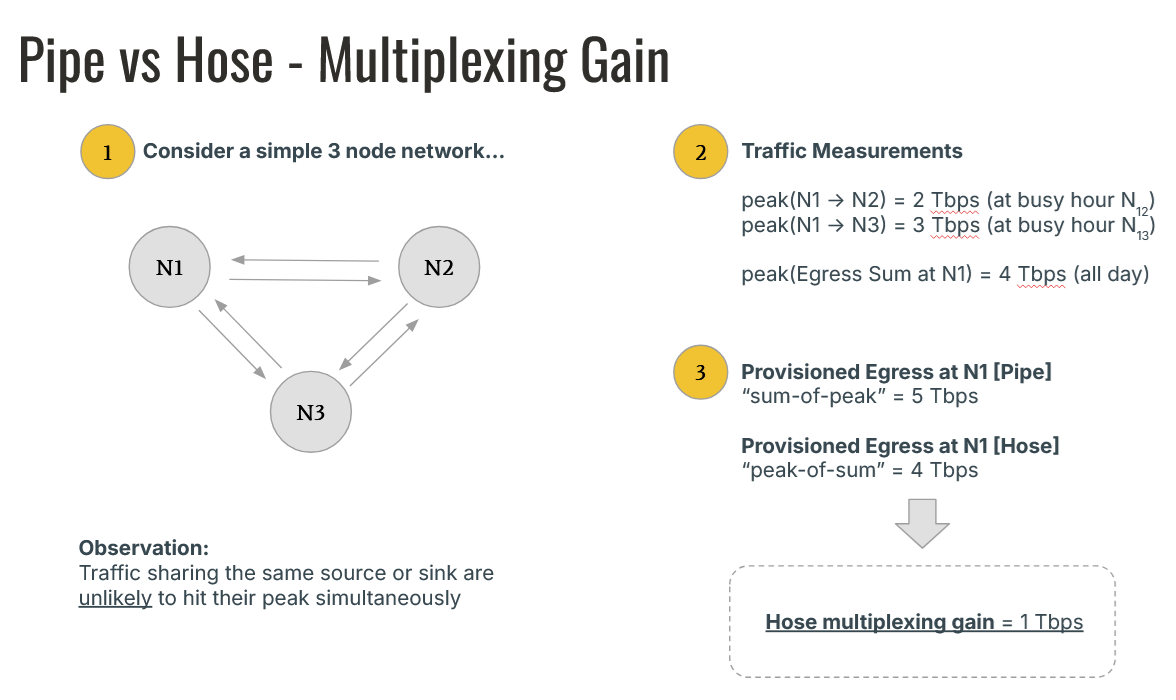
The traditional Pipe model plans for peak demand between every site pair — provisioning for the “sum of peaks.” This often leads to over-provisioning and inflated costs.
The Hose model flips the perspective:
- Forecast per-site ingress/egress instead of every site-pair.
- Capture the “peak of sum” traffic, realising multiplexing gain since site-to-site peaks rarely occur simultaneously.
- Enable scalable growth on a per-node basis, just like compute and storage.
Results & Benefits
By combining Hose-based traffic modelling with integrated optical/IP planning, networks can achieve:
- Lower capacity requirements – Multiplexing gain directly reduces CAPEX.
- Operational cost savings – Less excess capacity to maintain reduces OPEX, energy and space.
- Resilience to traffic dynamics – Natural absorption of variation and surges.
- Stable demand signals – Easier and more accurate forecasting.
- Alignment with service infrastructure – Per-site scalability like compute and storage.
- Sustainability – Reduced energy use and carbon footprint.
👉 The result: a backbone that is smaller, smarter, greener and more resilient.
Proof of Concept: Call for Partners
We’re seeking partners to engage in a proof-of-concept (PoC) to validate this backbone planning approach in real-world settings.
Objectives of the PoC:
- Cost Benefit – Validate multiplexing gains and quantify CAPEX/OPEX savings versus current methods.
- Resilience – Demonstrate robustness under realistic traffic dynamics and failure scenarios.
- Efficiency – Quantify time savings in producing backbone plans across short- and long-term horizons.
- Integration – Prove seamless fit with existing workflows and planning systems.
Who should engage?
This solution is especially valuable for operators with complex backbones but without hyperscaler-sized planning teams:
- Tier-1 & Tier-2 Carriers
- Backbone Infrastructure Providers
- Cloud & Edge Providers
- Subsea & Regional Operators
- Network-as-a-Service Providers
- NRENs and Research Networks
Let’s build the backbone of the future — together
Efficient, resilient and sustainable planning is critical to meeting tomorrow’s bandwidth demands. We believe Hose-based, integrated IP+optical planning is the way forward.
Interested in partnering with us?
📩
leigh@pozibl.com